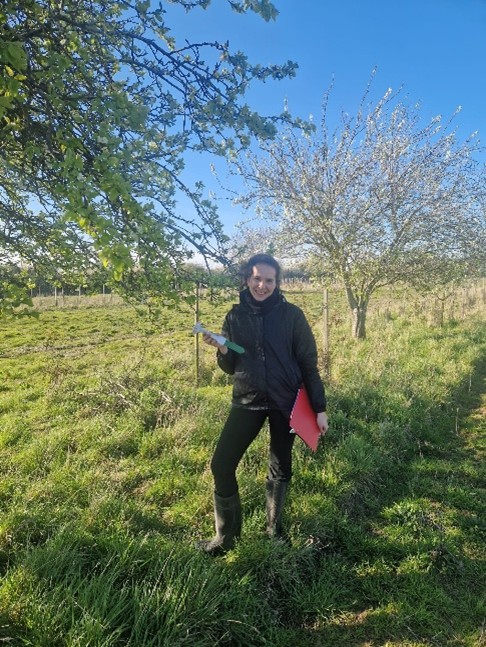
Chryssa’s PhD research is looking at how does silvoarable farming [agroforestry which combines crops and trees, as at Wakelyns] impact climate resilience compared to arable farming.
We are aware that silvoarable farming can provide many environmental and production benefits currently. We suspect that many of these benefits will increase under climate change via two main mechanisms:
Microclimate buffering
Silvoarable alleys can help moderate rising temperature and protect crops against extreme weather events. This can indirectly improve water regulation by enhancing infiltration, soil moisture retention, and facilitating hydraulic redistribution, thereby reducing crop drought stress and stabilising yields under increasing climate variability.
Improved soil health and biodiversity
Silvoarable alleys improve soil health and promote biodiversity, which creates more resilient farming systems for wildlife and production.
While there is already good evidence for the benefits of silvoarable systems on soil health and biodiversity, the links between microclimate, climate resilience, and crop production are less well understood.
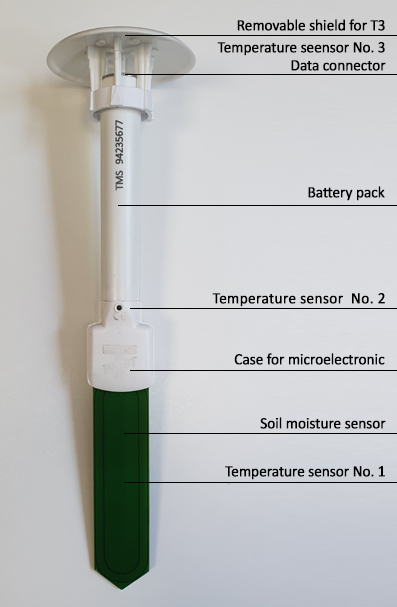
Thus, the aim of this research, is to investigate this with a field experiment that focuses on the microclimate conditions and the alley crops or vegetation, including water stress and yield. The main indicators being measured are aspects of microclimate, particularly temperature and moisture. These are being monitored using the TOMST dataloggers, which record soil temperature and moisture at -6cm and above ground temperatures at +2cm and +15cm.
At Wakelyns, 18 dataloggers have been installed across the North Field along six transects within two grass alleys, with a further 18 dataloggers to be installed in the remaining two alleys, and an additional nine dataloggers installed in the arable control field along three transects.