
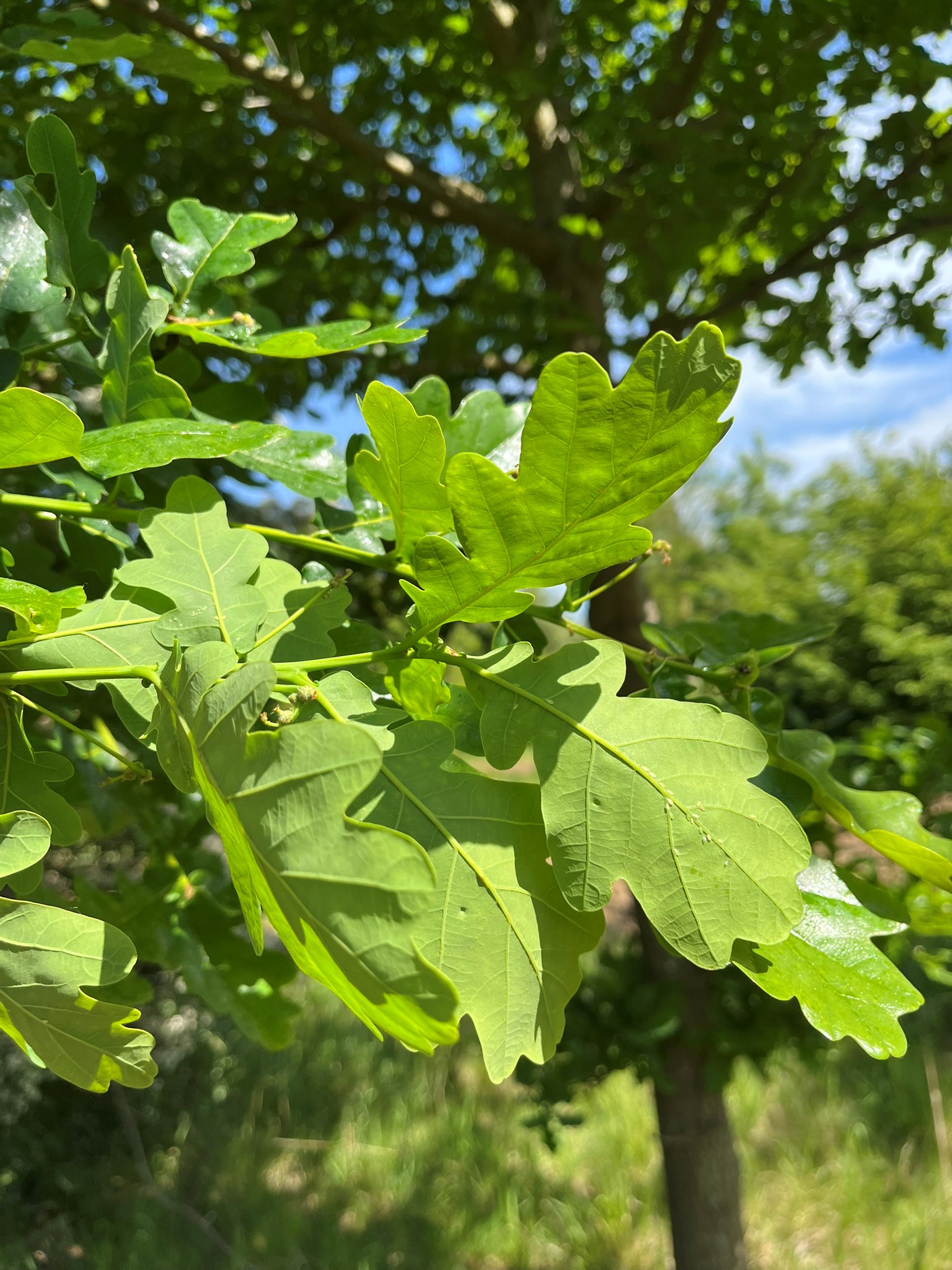
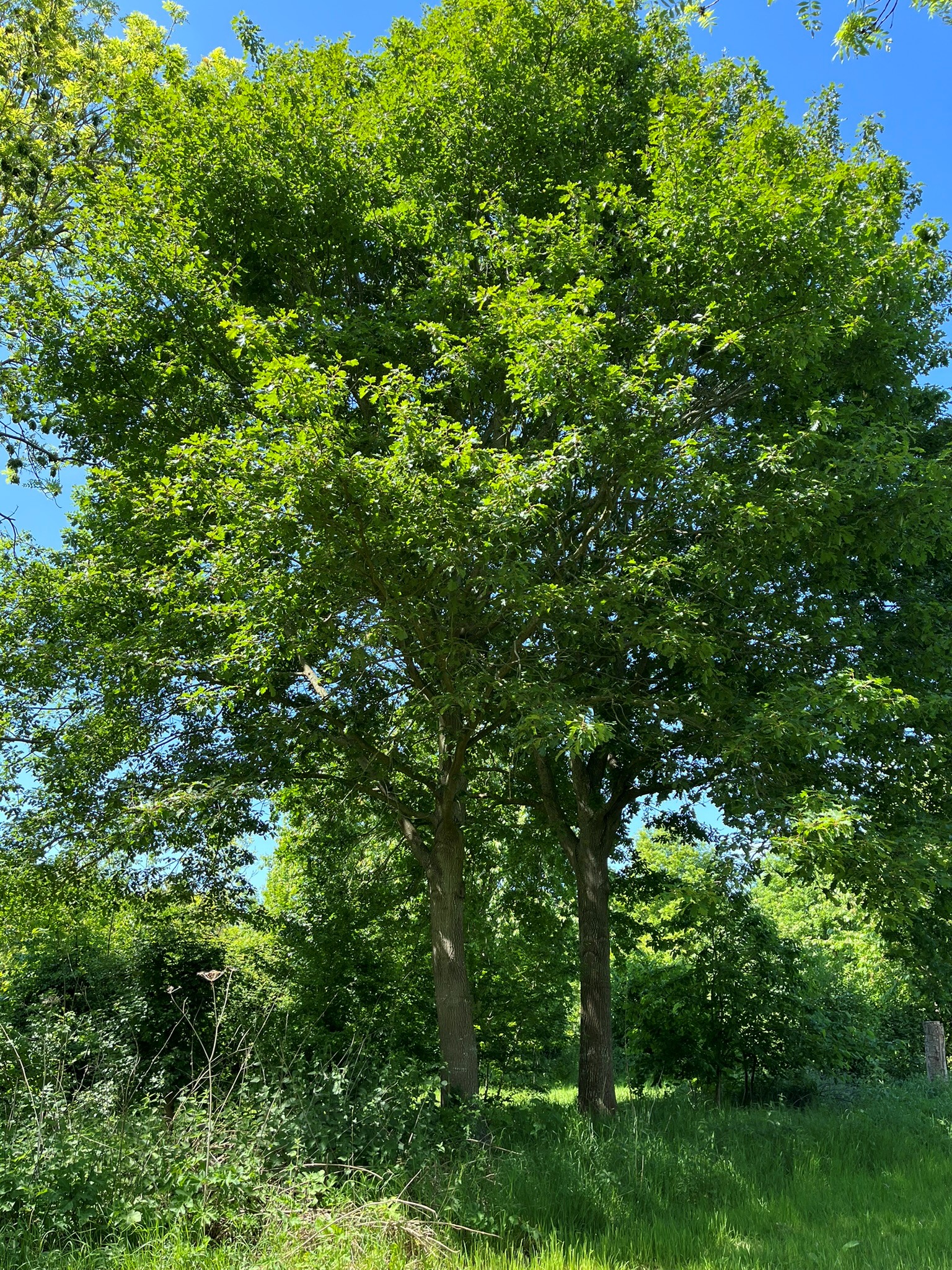
Quercus petraea
Carbon Sequestration: 20 kg/CO2e/year
Habitat Value: Very high value, especially for mycorrhizal fungi, wood-decay fungi, invertebrates, seeds, and epiphytes.
Preferred Conditions: Well drained, moist soils. Not shade tolerant. Moderately exposure tolerant.
To most visitors to Wakelyns the 30-year-old planted oaks in the field rows of the Hardwoods field are simply ‘English Oaks’. There are also several fine mature oaks in the hedgerows, but although superficially the same, the planted oaks are all sessile (Quercus petraea), whereas the older hedgerow specimens are pedunculate (Quercus robur). Luckily for my career as Arborist at Wakelyns, I knew the difference. When I was originally ‘interviewed’ for the job, Professor Martin Wolfe asked me what I thought of the planted oaks. After a moment’s hesitation I ventured, “They’re all sessile aren’t they?” “Well observed”, replied Martin, and I got the job!
It is unusual to see sessile oaks growing in Suffolk. They occur mainly in upland areas (over 300 m) with higher rainfall and sandy/rocky soil, typically in Wales, Scotland and Ireland. After all, the term petraea means ‘of rocky places’. In eastern England it is generally the pedunculate oak that predominates. However, foresters are said to prefer sessile oak timber, as the grain tends to be straighter and less prone to cracking and warping. Those at Wakelyns have generally grown very well, some, like these two, being now over 10 m high, with impressive trunk diameters of 40-50 cm. Undoubtedly the rich water-retentive clay soil on the farm has helped compensate for the much lower rainfall of East Anglia, compared to the west and north of Britain.
In terms of management, the potential timber value of the oaks is very high. To thin out the significantly dense canopies and promote growth on the best specimens, I attempted pollarding about eight trees. However, this was not successful, as two immediately died, and the rest re-grew inconsistently, with noticeable attacks of oak mildew, restricting regrowth. I soon took the decision to curtail any future pollarding of these particular oaks.
The best means to identify the difference between sessile and pedunculate is to study the leaves and (when visible) the acorns, specifically the stalks on each. The term ‘sessile’ means ‘stalkless’, but refers to the acorns, whereas the leaves have noticeable leaf-stalks. In contrast, the pedunculate oak has virtually no measurable leaf stalk, but quite obvious acorn stalks!