
Tilia cordata
Height / DBH: 20-37m / 6m (unmanaged)
Carbon Sequestration: 28 kg/CO2e/year
Habitat Value: Moderate value. High value for mycorrhizal fungi, leaf litter, pollen, and nectar
Preferred Conditions: Moist, fertile, deep soils. Shade tolerant. Not exposure tolerant.
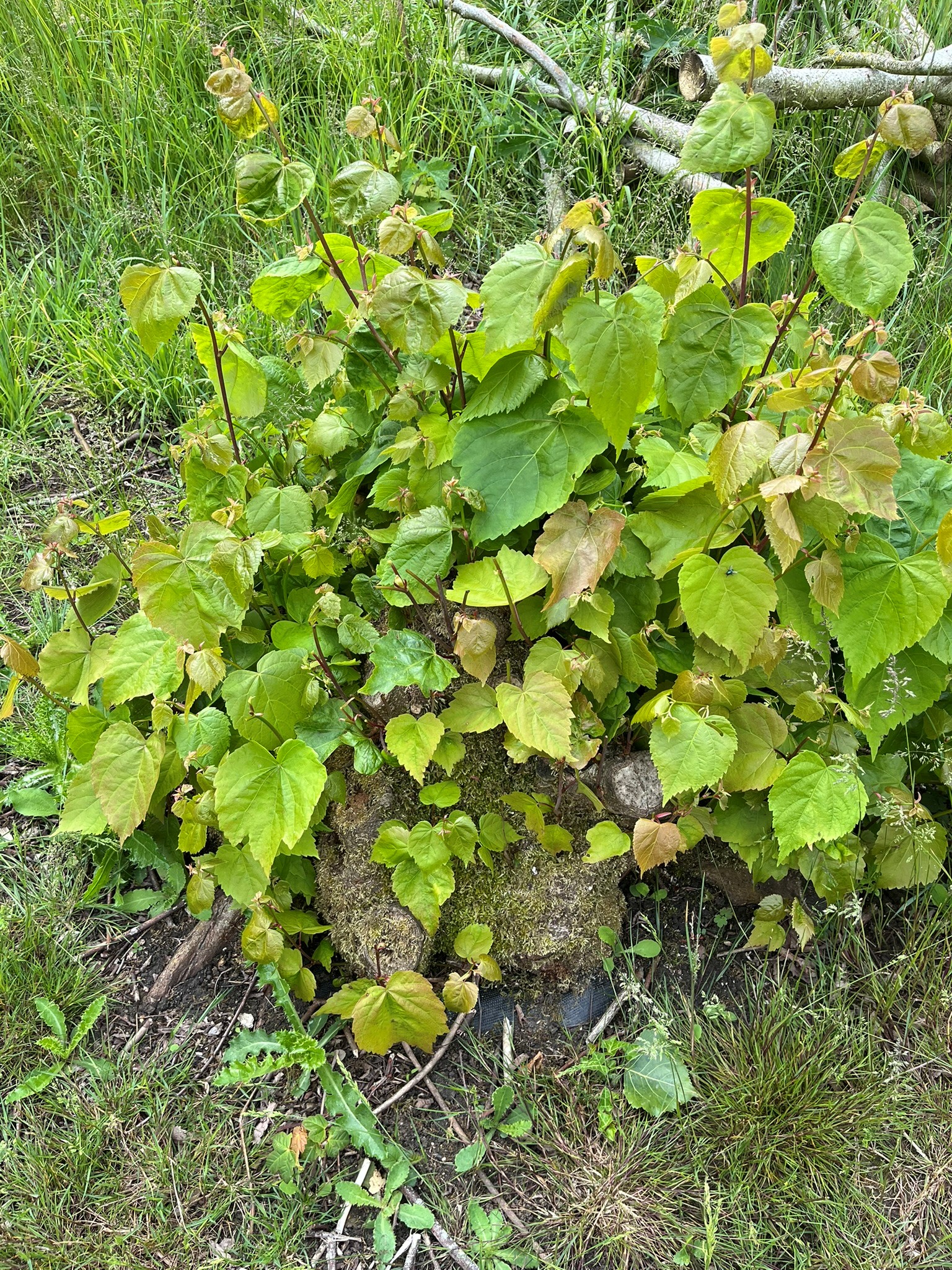
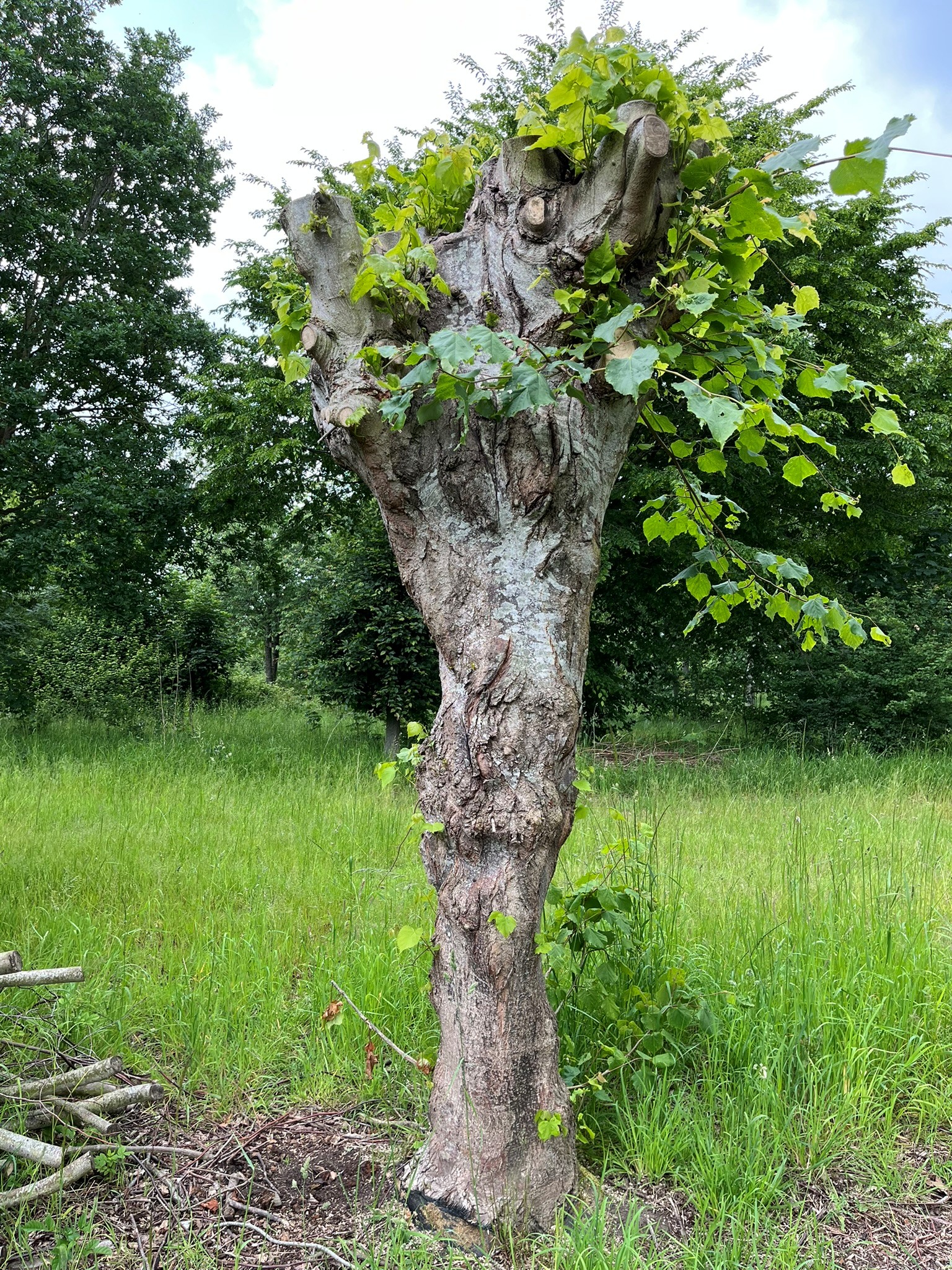
These two small-leaved lime trees were planted in 1993/4 as part of the ‘Timber Hardwoods’ Field, along with a selection of eight other native/naturalised species.
Small-leaved lime has several useful properties. The most well-known is probably its smooth, soft, white timber, which has long been sought-after by woodcarvers, the most famous historically being Grinling Gibbons. This species of lime has also long been coppiced and pollarded, since it responds extremely well to both, producing numerous vigorous shoots which can be harvested every 3 to 6 years. Traditionally, the inner bark (bast) was separated from the branch wood and bark proper, to be processed into cord or even rope. Although not giving a high quality of firewood, the productivity and ease of cutting of Small-leaved Lime makes it a valuable source of fuel.
These two trees, and others like them, are placed in off-set pairs in the north/south tree lines with the original aim of thinning to the most potentially valuable timber-producing specimens of each pair. However, when the initial felling was carried out the stumps regenerated quickly, coppice fashion. It was decided to treat all the regenerating stumps as part of the overall coppice rotation which includes the large-scale plantings of hazel and willow. A problem arose when, after a few years, the sheer quantity of fast-growing shoots began to impinge on the crop alleys, causing an obstruction to the cultivators. By this time, I had been granted more responsibility for the Wakelyns tree management, so I introduced pollarding as an alternative to the ‘accidental coppicing’. This proved a success, with the shoots lifted higher off the ground and causing less obstruction.
These two trees clearly show the difference between recent re-coppicing and re-pollarding. The regrowth pattern is similar, but there are obvious signs of browsing on the low coppice shoots. For many years, the cut branches have been chipped and used as fuel in the farm’s woodchip boiler. More recently, an alternative use for the chipped branches has been to incorporate them into the vegetable growing alleys as ‘ramial’ soil enrichment.