Welcome to CCBS
Help secure Wakelyns as a community owned and governed public facing resource
Chris Packham CBE, environmental campaigner:
“Wakelyns is a magical oasis filled with life…a tried and tested alternative to contemporary industrial agriculture”
Josiah Meldrum, co-founder Hodmedods:
For more than 30 years Wakelyns has been an inspirational model for agricultural change in the UK. Demonstrating through research and practice that a diverse, complex farmed landscape is not only ecologically, economically and socially viable right now, but the only approach that offers future hope in the face of climate chaos and collapsing biodiversity. I feel fortunate to have watched, been involved with, and to have been shaped by that work for 25 years. I could name dozens of farms changed for the better through a visit to Wakelyns, and I know hundreds more have been transformed by the research and advocacy Wakelyns has supported and inspired. I’m really excited about this next phase, where Wakelyns’ ownership moves to the community it has built to continue its pioneering and critically important work.
Robert Macfarlane, nature writer based in Cambridge:
“Wakelyns innovations in population grains and agroforestry – combining tree crops with grain crops and market gardening – are vital for the future of English farming… It is wonderful to think that, through this share offering, Wakelyns should soon be owned by the community and will be able to be run forever for the benefit of that community and of nature, through varied farming methods and flourishing biodiversity”
Jo Smith, Senior Researcher, MV Agroecology Research Centre, Portugal and Associate Editor, Agroforestry Systems:
“Having been involved in agroforestry research for over 15 years in both the UK and Europe-wide, I can’t over-emphasize the importance of Wakelyns as a mature and unique silvoarable system that demonstrates a number of practices ranging from alley cropping short rotation coppice to timber and fruit production. Such sites are incredibly rare across Europe. Over the years, I have collected data from Wakelyns on everything from tree yields, energy use and production, economics, crop and ley growth, pests and diseases, through to biodiversity both below and above ground. While other UK long term agroforestry research sites have been sold off or removed, it is so important that Wakelyns continues as a functioning farm, not only providing a research site but also an inspiration to students and researchers”.
Andy Dibben, market gardener & author of Silva-Horticulture:
“The science and farming research at Wakelyns has been pivotal in helping shape future farming system thinking”Stephen Briggs, organic farmer/adviser & AHDB Vice Chairman:
“Wakelyns has been an invaluable source of inspiration and knowledge to practitioners, academics and policymakers.”
John Snape, crop genetics researcher and John Innes Centre Emeritus Fellow:
“Martin Wolfe was a pioneer of sustainable agriculture and a proponent of sustainable methods of farming well before it became mainstream. One of his major ideas was to use genetic diversity as a tool for controlling diseases in crops without the need for environmentally damaging sprays. Much valuable research was then, over the years, performed at Wakelyns.The role of Wakelyns in promoting and maintaining the YQ population and Martin’s ideas of sustainable agriculture is essential for the future adaptation of farming methods to low input agriculture and buffering populations against climate change.”
Kimberley Bell, baker, Small Food Bakery (Winner, BBC Good Food award):
“Wakelyns Agroforestry is a vital example of the kind of farming we need to secure our future in the UK.”
Colin Tudge, Co-Founder, Oxford Real Farming Conference:
“Wakelyns is … showing in defiance of convention that trees, arable, horticulture, livestock, wildlife, and people can co-exist and interact to the advantage of them all.”
Sheila Das, Head of Gardens and Parks, National Trust:
“Wakelyns offers an incredible resource that extends learning far beyond its local reach and also transcends industry boundaries. Whilst the work carried out at Wakelyns speaks deeply to the agricultural community, those of us working in horticulture in garden settings (including growing food at garden scale) have really benefitted from visits to Wakelyns and been inspired by the overall agroecological approach which can directly transfer to any form of gardening. It is this broad reaching value of Wakelyns that makes it worthy of support for future learning and inspiration towards a more harmonious and nature friendly way of working with our land, whatever the context. I couldn’t be more supportive of this campaign.”
Executive Summary
Wakelyns is one of the UK’s leading agroforestry and agroecology demonstration farms, with over 30 years of pioneering practice. It also functions as a learning and enterprise hub, hosting international farmer and scientific events, school visits and community programmes, while incubating micro-businesses in food and crafts creating local employment.
Historically Wakelyns has been a privately run but public facing business. But one co-owners needs to realise his 50% share, creating the real possibility the site will be lost. To secure its future, the Wakelyns Charitable Community Benefit Society (WCCBS) has been established to acquire the estate and continue its work as a charitable enterprise.
WCCBS needs to raise £2.05m to acquire the site and fund a three-year programme developing its charitable work to ensure that Wakelyns will continue long into the future.
Wakelyns
Wakelyns, surrounded by a sea of industrial arable production, is an oasis of trees, alive with bird song and insects. Integrating trees for timber, energy and fruit production into an organic crop rotation, this 23.5 hectare innovative farm in Suffolk was established 34 years ago by the late plant pathologist, Professor Martin Wolfe and his wife Ann, to put into action his theories of agrobiodiversity as the answer to achieving sustainable and resilient agriculture. The farm has a unique combination of trial/demonstration areas of agroforestry in the form of short rotation cropping of hazels and willows, mixed fruit tree lines, mixed timber tree lines, and lines combining fruit and nut trees with vines.
Wakelyns is the UK’s and perhaps Europe’s oldest, most diverse and most visited demonstration agroforestry farm, providing a practical example of the food and farming systems critical for the future of UK farming: only two farms in the UK (within only eleven UK sites) on the Oxford University Nature Based Solutions Initiative’s global interactive map of best practice.
A brief history of agroforestry
The term ‘agroforestry’ was first coined in 1977 to describe the integration of trees and agriculture, but people have been using trees in agriculture for thousands of years. Livestock grazing in wood pastures, using trees as a shelter belt to protect crops and livestock, pollarding – the practice of cutting branches from trees to obtain leaf fodder for feeding livestock and/or wood for fuel – are all examples of agroforestry.
Wood pastures, such as the New Forest, were historically widespread across the country, but the move towards industrial farming following World War II saw the majority disappear and agroforestry diminish. However, in recent years there has been an upsurge in people looking for ways to create more sustainable and nature-friendly farming systems by integrating trees into field crops or pasture systems. Now Government climate change and agriculture policy will support agroforestry planting on 10% of all arable land in England by 2050.
Wakelyns Research
Over many years Wakelyns has been a key site for those looking to research the implementation and benefits of agroforestry. Of particular significance has been the long association with the Organic Research Centre (ORC) undertaking groundbreaking research across a range of issues related to organic agroforestry at Wakelyns. Some of the projects conducted with the ORC and other institutions are listed below.
- Agforward – Wakelyns was a focal point for a €8million EU funded project that looked at promoting appropriate agroforestry practices that advance sustainable rural development.
- Agromix – a €7million EU funded project looking at the role of mixed farming systems in supporting resilience to environmental change. Wakelyns was used to investigate how mixing trees and crop production affects biodiversity.
- A University of Reading study that used Wakelyns as one of its sites found that agroforestry systems provide better pollination service than monocultures having twice as many solitary bees and hoverflies and, in arable systems, 2.4 times more bumblebees.
- Rothamsted Research has recently been investigating the soils at Wakelyns to understand the effects of agroforestry on soil health.
Wakelyns Population Wheat
Along with being a pioneer of agroforestry, Wakelyns has also been an influential innovator in agroecological wheat production. The YQ wheat developed at Wakelyns in partnership with the John Innes Centre does not require any of the fertilisers and pesticides required by the monoculture varieties used in intensive farming. Its name comes Yield stability and Quality parentage.
The YQ at Wakelyns has now been through over 20 generations of natural field selection on site, each year better adapting to the climate, soil and landscape. Over the years batches of grain have been taken from Wakelyns to grow the YQ population elsewhere. As a result, ’YQ’ is now being grown all over the UK and abroad, with farmers growing and saving their seeds every year to perpetuate the genetic diversity and resilience of the crop.
“Some very special times were the planting of trees at Wakelyns in 1994 and 1995 and the beginnings of the work with the wheat composite cross populations (CCPs). Martin’s vision was to enhance diversity among crops and within crops. This has inspired scientists across Europe and the (CCPs) are now growing from Hungary to the UK.”
Maria Finckh, Professor of organic farming at University of Kassel.
Wakelyns Community
Wakelyns has latterly become recognised as a valuable international, national and regional learning centre for a wide range of organisations and groups. Recent events have included:
- Oxford Real Farming Conference held two-day events showcasing Wakelyns projects, from grazing sheep for weed management to growing legumes for Hodmedods and YQ population wheat for the on-site bakery enterprise showing participants integration of agroforestry into farm practice at different scales.
- The Land Workers Alliance – whose vision is a food and land-use system where everybody, regardless of income, status or background has access to local, healthy, affordable food, fuel and fiber from producers they can trust – have held their Eastern Region Meetings at Wakelyns.
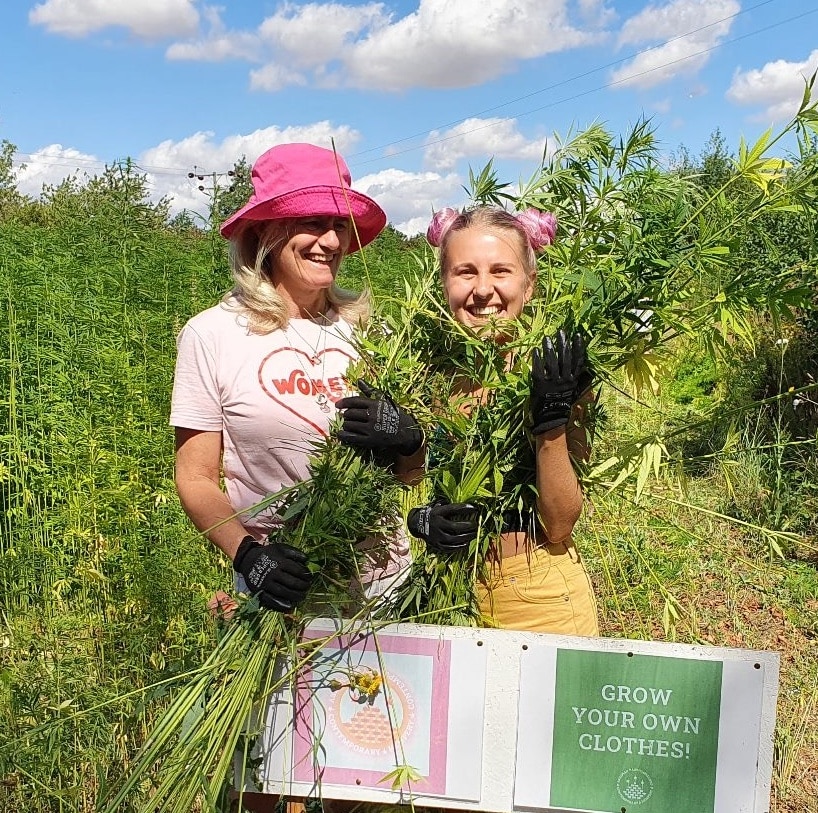
Wakelyns-based environmental education charity, Natural Habitat, has organised visits from both farmers and local primary schools, enabling pupils to learn new skills in weaving willow, taste our produce and try processing hemp to make fiber.
Wakelyns also organises events:
- In 2021 Wakelyns initiated Agroforestry Open Weekend with 6 participating farms, mostly near Wakelyns in East Anglia. The aim of the event was to inform people of the benefits of agroforestry. 2025 saw 50 participating sites across the UK and beyond – including Finland and Costa Rica.
- Wakelyns was a UK pioneer in growing organic lentils in conjunction with Hodmedods. The annual Wakelyns Dal Festival was launched in 2023 with 11 dal chefs using coral and black (‘beluga’) lentils from the 2022 harvest (along with guest lentils from other UK growers). The event has gone from strength to strength with people attending from all over the UK.
Other events through the year centre on some aspect of the land, crops and crafts associated with Wakelyns – making the site a valuable community asset.
Wakelyns Enterprise
In addition to its agroforestry activity, Wakelyns has been developing ‘enterprise stacking’ – a social and land use strategy allowing multiple enterprises to operate collaboratively across the site, collaboratively generating revenue streams.
Currently ten micro enterprises are operating on site using different models of partnerships and joint ventures with Wakelyns depending on their business model, with an emphasis on short sourcing, on-site production distribution chains and co-operative working. This helps create employment and helps show-how produce can be sourced and sold locally
Businesses include/have included bakery, catering, willow-weaving, wood products, fruit-juicing, and vegetable gardening.
“????quote to be inserted.”
Nicola Hordern and Lindsay Wright, Silva Kitchen and Bakery at Wakelyns
The Future of Wakelyns
Wakelyns has been a privately owned but public facing business, established by its founders Professor Martin Wolfe and his wife Ann and subsequently inherited by their sons.
One son needs to realise his 50% share. This presents the very real risk that, without positive action, Wakelyns will have to be sold or fragmented and its potential as a continuing resource to researchers and the local community will be lost.
Our vision is that Wakelyns will become a community owned asset, preserving its heritage and securing its future. Acting on advice from the Plunkett Foundation and Cooperatives UK, the Wakelyns Charitable Community Benefit Society (WCCBS) has been created to acquire the site for public purposes and then work to preserve and build on Wakelyns’ heritage, expanding on all aspects of its existing work, so that:
- Wakelyns will be a crucial demonstration site for agroforestry and climate-resilient farming, both nationally and internationally. A unique living lab which comes from 30 years of organic agroforestry practice.
- Wakelyns will be a top research and education location, hosting ongoing trials and collaborations with universities, NGOs and policymakers.
- Wakelyns will be a farm-based community institution relevant to and beyond East Anglia incubating new businesses that support the local economy. Proving in practice how to create short food and material chains and build business collaboration community.
- Wakelyns will be an exemplar of nature recovery and community stewardship. Opportunities for biodiversity protection and enhancement will be explored with guided access, volunteering and local engagement
The Community Benefit Society is a tried and tested model which allows for wide community investment in a way which allows people who have more to invest more, while those with less can still be members. It offers one member one vote, regardless of the amount invested, which provides the best democratic governance and the widest stakeholder engagement, with an ‘asset lock’ which protects the Wakelyns site. Being a charity in the form of a Charitable Community Benefit Society brings access a wider range of grants whilst being able to trade more easily than a charity registered with the Charity Commission.
Around 150 people, many experts in their field and representing a wide range of organisations and interests, were initially engaged regarding the best way to secure Wakelyns’ future. This led to a group of 14 people expressing an interest in being ‘founder members’ of WCCBS. They are:
- Donald Peck (chair) – Ex-Chair of the Organic Research Centre
- Ben Raskin – Herd of Agroforestry at the Soil Association
- Chris Darby – Former CEO of the Nutrition Society
- Jeremy Guggenheim – Semi-retired film maker and photographer
- Di Warne – Chair of Fressingfield Parish Council (Wakelyns is in Fressingfield)
- Will Simonson – Agroforestry Lead at Organic Research Centre
- Gyan Sagar Saraswati – Academic specialising in dryland agricultural rainwater management
- Daniel Hudson – Founder of Proposition, an ecological charity
- Andy Hall – Business and Estate Manager
- Richard Stein – Solicitor
- Ruth West – Co-founder of the Real Farming Trust and the Oxford Real Farming Conference
- Gavin Sturge – Finance Director, Gatehouse Chambers
- Ben Evans – Suffolk farmer with an interest in agroecology
- Professor Ulrich Schmutz – Co-founder of Coventry University’s agroecology research centre.
Later in 2026 there will be a community share issue. Future board members will be elected from the shareholders.
David Wolfe, who has been managing Wakelyns with his wife Amanda Illing since 2020 will transfer management of Wakelyns to WCCBS gradually so as to ensure continuity and stability.
WCCBS will initially take responsibility for the agroforestry fields and farming, developing an agroforestry plan for approval by the Forestry Commission; appointing a new manager will allow David and Amanda to step back and so secure the future operations including the accommodation and events business, with full community ownership and governance in place by 2030.
Funding
We now need to raise £2,050,000 to purchase the site and fund an initial three-year programme of activity to further the WCCBS’s charitable objectives.
Whilst we do not underestimate the scale of this task, it is made considerably more achievable by David Wolfe agreeing to gift his 50% share (£850,000) to WCCBS.
This means we have £1,200,000 to raise through philanthropic donations and the WCCBS community share issue. Individuals and organisations will be able to become members by buying £1 shares, with the minimum shareholding being 114 shares and the maximum being 100,000 shares.
We have a capital expenditure budget and financial projections available. If you would to receive them or any further information, or if you would like to visit Wakelyns, please contact info@wakelyns.co.uk