Summer 2026 update from one of the Organic Research Centre Projects at Wakelyns
New research based at Wakelyns suggests that trees growing alongside arable crops could help protect harvests from the worst effects of climate change—but the timing of that protection may be just as important as the shade itself.
The study, “Agroforestry protects arable crops from climate shock during critical early-season phenological stages,” has been published in Agronomy for Sustainable Development (https://link.springer.com/article/10.1007/s13593-026-01129-3).
Researchers used the detailed Hi-sAFe computer model to simulate 100 years of crop and tree growth at Wakelyns, from 2001 to 2100. The study focused on winter wheat and peas grown in the North Field and compared crops growing between rows of walnut trees with crops growing in an equivalent open field. Two possible climate futures were examined: an intermediate greenhouse-gas emissions scenario and a very high emissions scenario.
Wakelyns provided an especially valuable setting for the research. Established by Professor Martin Wolfe in 1992, it is one of the UK’s oldest and most mature agroforestry sites. Its long-established tree rows, organic arable rotation and history of practical research make it possible to investigate questions that cannot easily be answered through short-term field trials.
Figure 1. Wheat growing between rows of willow coppice at Wakelyns Agroforestry. Wakelyns’ mature alley-cropping systems provide a real-world setting for studying interactions between trees, crops and the farm environment. Photo: Organic Research Centre.
Protecting crops when conditions are at their worst
The results suggest that agroforestry does not simply increase wheat yields every year. In most simulated years, winter wheat grown in the open field yielded slightly more because the trees competed with the crop for light, water and other resources. Before 2080, this average difference was approximately 5%, excluding the most exceptional years.
However, a very different pattern emerged during occasional years of severe climatic stress. When hot, sunny and dry spring conditions caused open-field wheat yields to collapse, wheat growing between the trees continued to produce a much more reasonable harvest.
Under the very high emissions scenario, the clearest examples occurred in the simulated years 2026 and 2044. Agroforestry wheat yields were 79% higher than open-field yields in 2026 and 125% higher in 2044. In these years, the trees effectively acted as a climate shock absorber, limiting the risk of a disastrous harvest.
This distinction is important. The statistical analysis did not show that agroforestry made wheat yields less variable across every year. Instead, its principal benefit was the reduction of extreme downside risk: sacrificing a small amount of production in many ordinary years while helping to prevent catastrophic losses in occasional bad years.
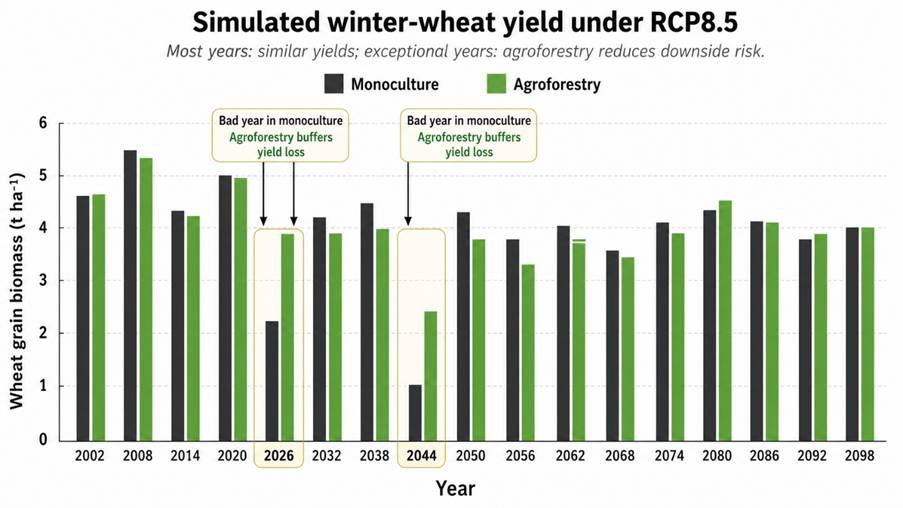
Figure 2. Simulated winter-wheat yields under the very high greenhouse-gas emissions scenario, comparing monoculture and agroforestry at Wakelyns. Yields were similar in most years, but in the exceptional years 2026 and 2044 the monoculture yield fell sharply while agroforestry maintained substantially higher production. Source: Tosh et al. (2026), adapted from Figure 3A.
Peas also benefited from the trees, particularly under the more severe climate-change scenario. Pea yields varied considerably from year to year, but agroforestry frequently reduced the severity of poor harvests. In some simulated years, the crop between the trees continued to produce when the open-field crop almost completely failed.
The protective effect on peas became stronger under the very high emissions scenario. This suggests that agroforestry could become increasingly valuable for some crops as climatic extremes intensify.
Why does the timing of tree leaf emergence matter?
Perhaps the most surprising finding was when the trees appeared to provide their protection.
It might seem reasonable to expect trees to be most beneficial during July or August, at the hottest point of the summer. Instead, the analysis identified a much earlier and relatively narrow window, around the end of spring and beginning of summer.
This period coincides with crop flowering and the beginning of grain filling. These reproductive stages are especially vulnerable to high temperatures, dry air and water stress. Stress at flowering can interfere with grain formation and substantially reduce the final harvest.
The modelled walnut trees came into leaf relatively late in spring, shortly before winter wheat began flowering. Their newly opened canopies appear to have provided shade and modified the surrounding microclimate just as the wheat entered this sensitive stage.
The timing may therefore offer an effective compromise. The trees did not cast dense shade throughout the earlier months, when the wheat could make productive use of the available sunlight, but they had developed sufficient foliage to provide protection by the time the crop became particularly vulnerable.
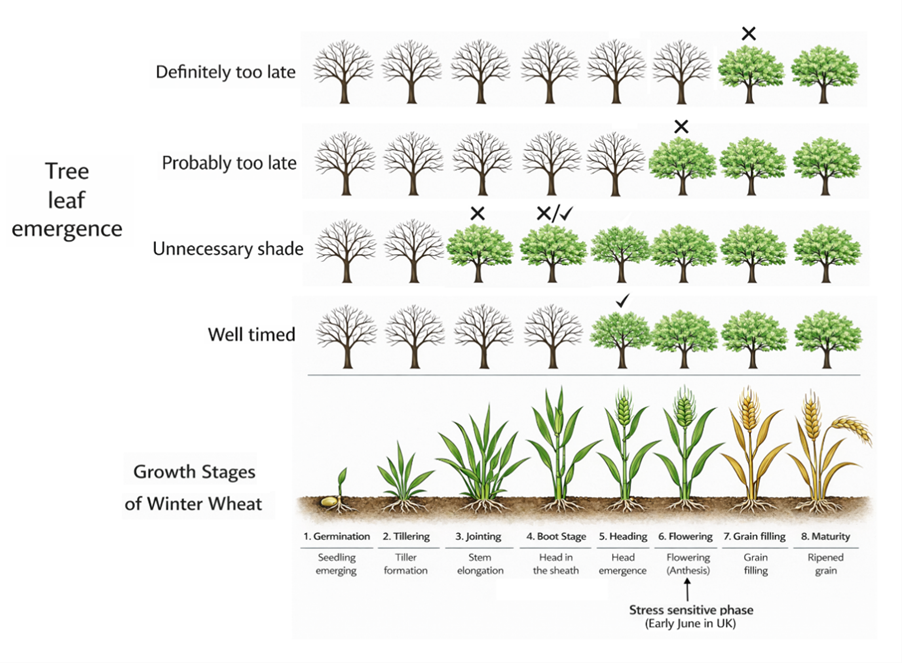
Figure 3. The proposed relationship between tree leaf emergence and the development of winter wheat. Trees coming into leaf too early may cast unnecessary shade, while trees coming into leaf during or after wheat flowering may provide protection too late. The most beneficial timing is likely to be leaf emergence a few weeks before the crop’s stress-sensitive flowering period. Conceptual illustration supplied by the research team.
This finding has practical implications for the design of new agroforestry systems. Farmers commonly consider the products a tree will provide, its mature size, rooting behaviour, spacing and compatibility with machinery. The timing of leaf emergence may be another important characteristic to consider.
A tree species whose leaves emerge very early could reduce crop growth through unnecessary spring shade. A species that comes into leaf after crop flowering may miss the period when protection is most valuable. Matching the development of the tree canopy with the development of the crop could help farmers obtain climatic protection while limiting competition.
Walnut appears particularly promising for winter-wheat systems in England because it normally comes into leaf relatively late, near the end of May and shortly before the wheat flowering period. By comparison, species that leaf in March or April could shade winter crops for several additional weeks before that shade is needed.
These conclusions are based on detailed modelling rather than a century of observed harvests. Further field measurements will therefore be needed to test the proposed mechanism under different weather conditions and with different combinations of crops, trees and agroforestry designs.
Looking at the productivity of the whole system
The study also examined land-use efficiency by combining crop production with the growth of the walnut trees. This was measured using the land equivalent ratio, or LER, which compares an agroforestry system with the amount of separate land that would be needed to grow the same crops and trees in monocultures.
Under the existing North Field configuration, LER consistently exceeded one only after approximately 40 years for peas and 80 years for wheat. However, this result needs careful interpretation.
Wakelyns was originally established to investigate biodiversity and agricultural resilience, rather than simply to maximise short-term commodity production. The model was also unable to include walnut production and did not count newer productive uses of the tree understories. Narrower understory strips, different tree spacing, alternative tree species and additional crops beneath or between the trees could all improve whole-system productivity sooner.
Overall, the study reinforces the importance of long-established research farms such as Wakelyns. Trees planted decades ago now allow researchers to investigate long-term questions about food production, climate adaptation and agricultural resilience. The results suggest that the value of agroforestry may not always be clearest during an average harvest. Its greatest value may become apparent when extreme weather places the whole crop at risk.
Help secure Wakelyns’ future
This research arrives at an important moment for Wakelyns. The Wakelyns Charitable Community Benefit Society, or CCBS, is raising funds to bring the farm into charitable community ownership and protect its long-term environmental, scientific and social legacy.
The CCBS plans to purchase one co-owner’s 50% interest in Wakelyns, while the other 50% would be gifted to the Society. This would safeguard the farm as a living laboratory for climate-resilient agriculture and food production, while supporting nature recovery, education and continued public engagement.
Supporters can help by donating or by becoming voting members of the CCBS. Membership is available through the purchase of at least 114 community shares, costing £1 each. Further information and details of how to take part are available on the Wakelyns CCBS page.