
Carbon Sequestration: 4.08 kg/CO2e/year
Habitat Value: Relatively low value. High value for mycorrhizal fungi, leaf litter, and seeds.
Preferred Conditions: Moist, fertile clay and alkaline soils. Shade tolerant. Not exposure tolerant.
The common Hornbeam is a native tree in Britain, often mistaken for the more widespread beech. It is particularly suited to heavy clay soils with plenty of water retention, and in such conditions can become the dominant species in a natural woodland. It has historically been coppiced and pollarded, yielding large quantities of high quality firewood, small dimension timber, and charcoal. The wood is extremely hard, and although not durable outdoors, it has traditionally been valued as a choice for tool handles, cogs in windmills and watermills, butchers blocks, and specific parts in pianos.
Hornbeam was included in the mix of nine tree species planted on a random basis in the ‘Water Field’ at Wakelyns Farm in 1994/5. It has grown extremely well, obviously enjoying the heavy wet clay and reasonably sheltered environment, which it prefers. Although theoretically planted with the ultimate goal of harvesting for timber, a rotational programme of pollarding has produced large quantities of high quality firewood and woodchip, the latter being used in the woodchip central heating boiler. A non-planted hornbeam on the farm died a few years ago. It was felled, and the sizeable trunk was taken to a local sawyer, who crafted some of the planks into a beautiful dining table, which is now on display at Wakelyns, a truly ‘virtuous circle’.
It is also a useful habitat tree spawning a dense canopy of regrowth shoots after each re-pollard (on average every 5-6 years), which birds seem to particularly favour for nesting. As Hornbeams can live for at least 400 years, including as pollards, this species can potentially remain a valuable feature of the forestry component of the farm for generations to come.
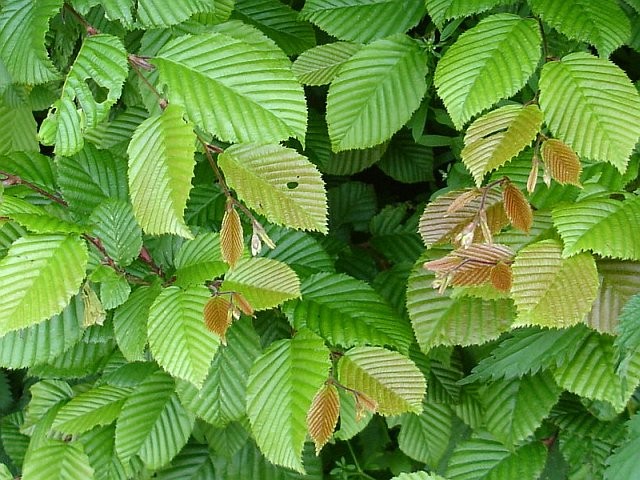
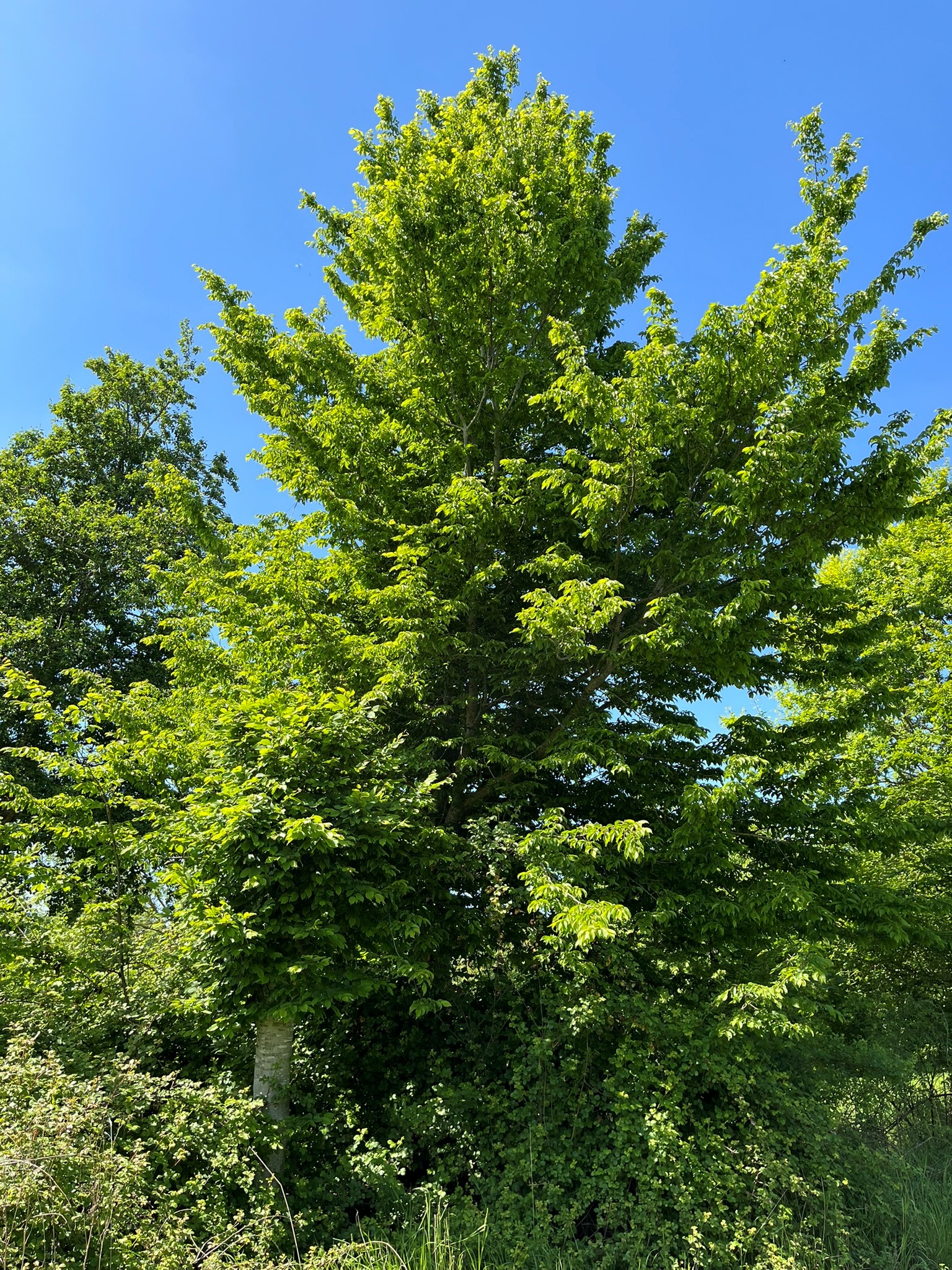
To identify common hornbeam look for the grey, smooth, fluted trunk, with a spreading dense canopy of complicated branches. The oval leaves turn yellow/bronze in the autumn. Hornbeam’s leaves are serrated and corrugated, and are held closer to the stems than Beech. Whilst beech can grow to at least 40m, hornbeam rarely reaches half that height, and often the canopy is as wide as it is tall. Like beech, hornbeam can be grown very successfully as a dense hedge, also retaining its dead leaves over winter.