Welcome to the Wakelyns CCBS
Please help us secure Wakelyns’ future
Wakelyns is at risk.
Buy shares in the Community Benefit Society and prevent the pioneering agroforestry research site from being sold on the open market.
With your help Wakelyns can continue to lead the way for regenerative farming for another 30+ years.
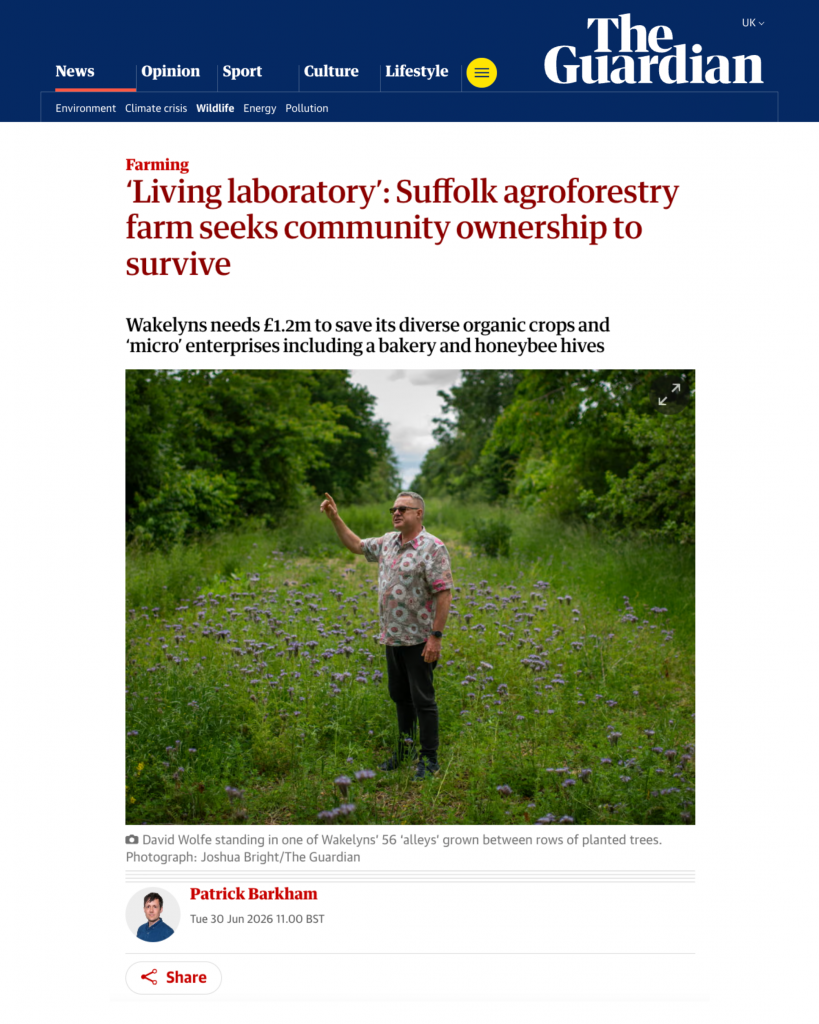
click on the image below to read all about it in The Guardian
There’s lots more detail below, but if you still need persuading, watch this short film: As Chris Packham says, “Wakelys is a national treasure!”
And here’s a lovely write up in Wicked Leaks; and coverage in the Farm Gate podcast here.
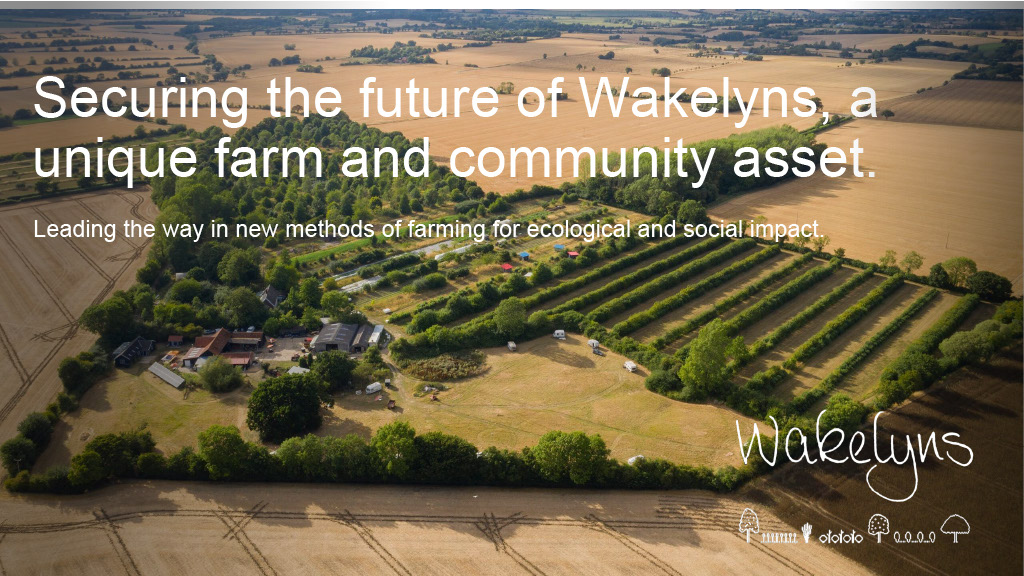
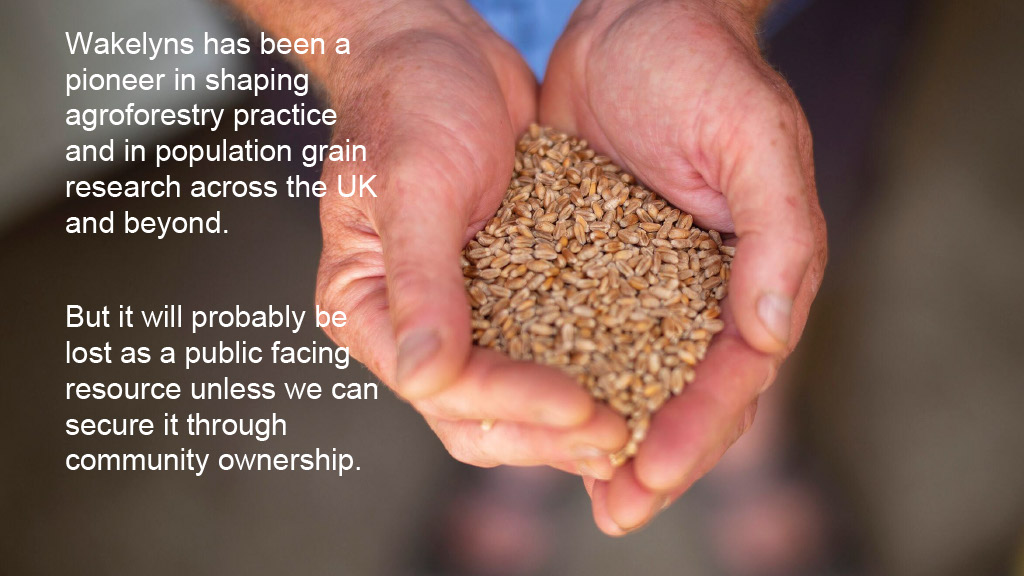
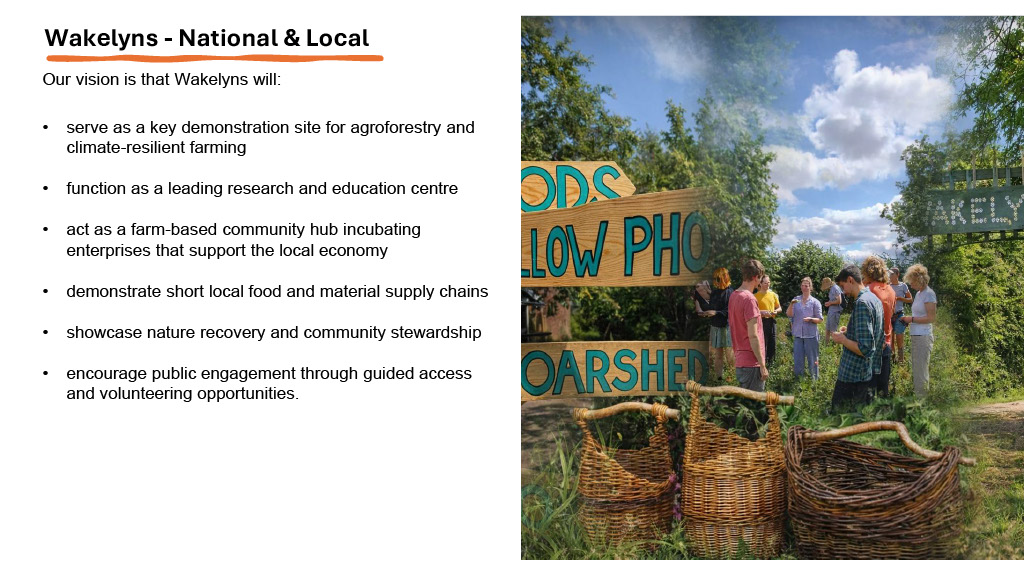
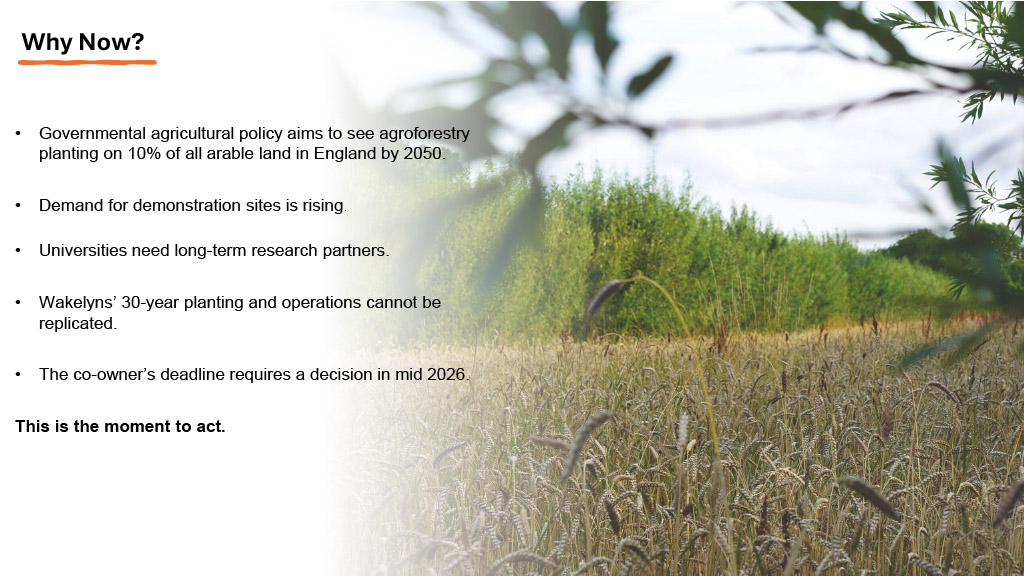
What’s the plan? We want to secure and enhance the long-term environmental and social legacy of one of the oldest, most-diverse and most-visited demonstration organic agroforestry farms in Europe, helping to tackle the nature, climate and social crises.
How will you do it? We will do it through charity ownership and governance by the Wakelyns Charitable Community Benefit Society (CCBS).
What do you want from me? We’d like you to become a voting Member of the Wakelyns CCBS by buying between 114 and 100,000 ‘community shares’ at £1 each (and ideally also making a donation on which the CCBS can potentially claim Gift Aid).
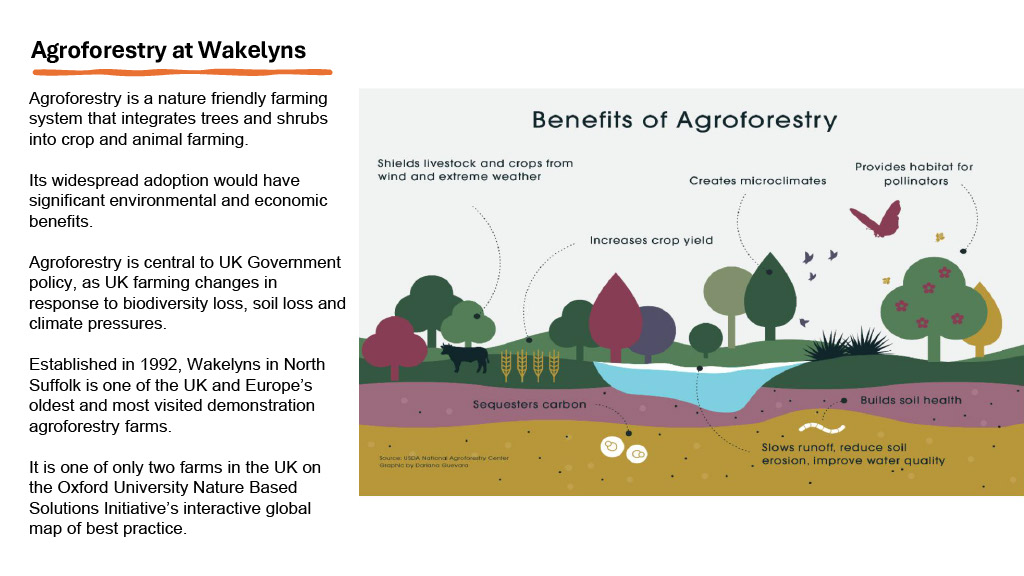
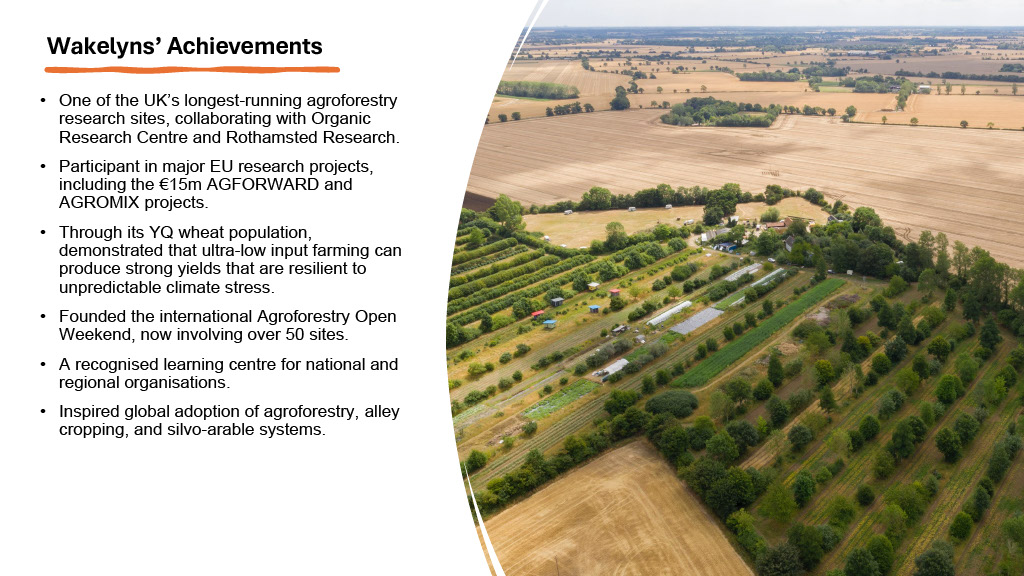
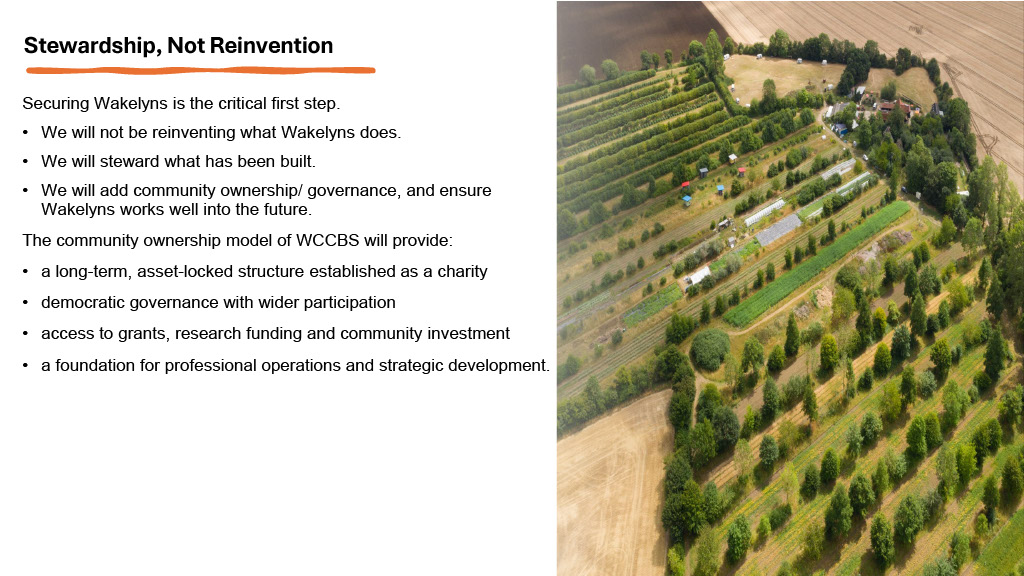
Established through first-mover agroforestry planting in 1994, Wakelyns in Suffolk has become a lighthouse site for progressive farming and land use. Wakelyns prioritises environmental protection and enhancement and community and social engagement, science and education:
- An oasis in the East Suffolk industrial farming landscape, supporting habitats including meadows, scrub, mature hedges, herbal leys, rewilding and agroforestry treelines (rewilding corridors).
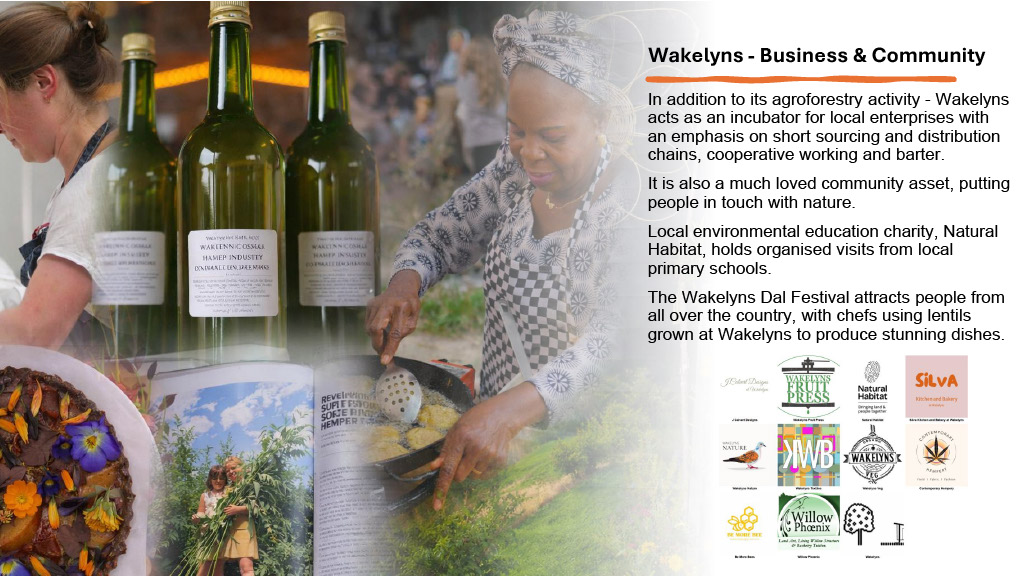
- A demonstration hub for international and scientific events, farmer, local school visits and local community programmes/events including its annual Dal Festival, engaging diverse communities from across Suffolk.
- An incubator for micro-businesses linked to the land including through cooking/ baking, craft or space for learning and wellbeing. Integral to the farming, the businesses create economic, health, environmental and social synergies, and business opportunities for local people combining production with habitat protection and enhancement.
- An inspiration for academic research (it was one of eight sites across Europe chosen to assess the long term benefits for habitats and nature of agroforestry and features in many other research projects). Long-term collaborator, the Organic Research Centre, produced a booklet and directory of its Wakelyns work and the contribution to sustainable and resilient farming. PhDs at Wakelyns study soil health, tree and crop interaction and climate forecasting. The Wakelyns YQ ‘population wheat’ (now grown around Europe, adapting to its local environment) gives food resilience without harmful synthetic chemical inputs.
How will you safeguard Wakelyns? If we can raise funds to purchase the 50% interest from one owner, the other will gift his share. This will safeguard and grow Wakelyns as a living laboratory for climate-resilient agriculture and food production, supporting nature recovery and ensuring long-term public and community engagement with nature, farming and food production.
How do I join in? Click here.
What if you don’t raise enough money? We will hold all the funds separately and not process membership applications and donations until we reach our target. If we do not reach the target, we will return your money and Wakelyns will be sold on the open market and likely be lost as a publicly accessible environmental and social resource.
What if I have more questions? There are lots more FAQs answered below. If you need more do please email and ask here.
More about Wakelyns and the CCBS plan
Some Frequently Asked Questions
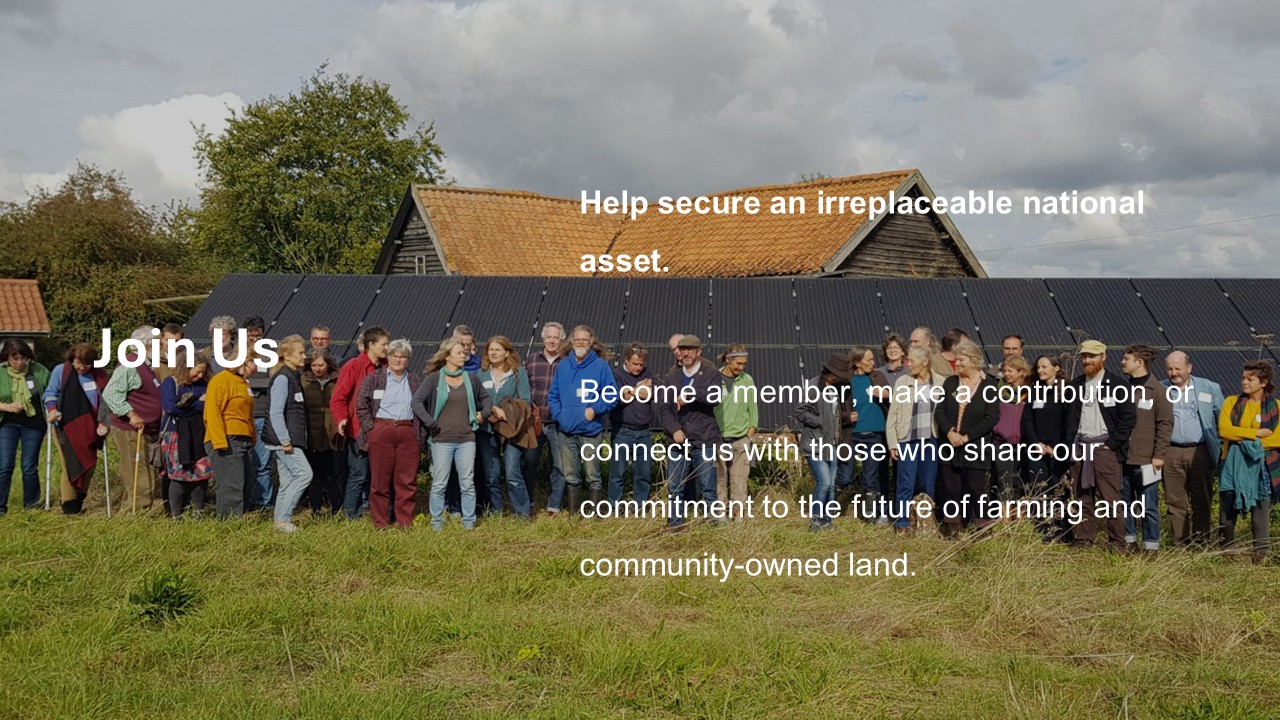
A:The legal process to create the Wakelyns CCBS was initiated by 14 ‘founder members’, all of them long-term friends of Wakelyns keen to help secure its future:
- the Head of Agroforestry at the Soil Association,
- a retired MAFF civil servant now working at the Norwich Institute of Sustainable Development,
- a documentary film maker,
- the former Chair of the Organic Research Centre,
- the Chair of the local Parish Council,
- the former head of the agroforestry research programme at the Organic Research Centre,
- a builder of communities internationally, and water engineer,
- the founder and CEO of an ecological arts organisation,
- a business and estate manager,
- a retired solicitor,
- a co-founder of the Real Farming Trust and Oxford Real Farming Conference,
- a practicing accountant,
- the co-manager/owner of an 80 acre farm also in Suffolk, and
- a professor in the Coventry research centre on agroecology.
The plan is that you and many others will join them as the Members of Wakelyns CCBS going forward. The Board – responsible for running Wakelyns – is elected from the Members at an AGM each year.
A: If the Wakelyns CCBS can raise the funds to purchase the 50% interest of one co-owner, then the other (David Wolfe) will gift his 50% to the CCBS.
The ‘assett lock’ built into the CCBS (which will prevent Wakelyns being sold and the funds dissipated) means CCBS ownership will secure it for the future.
The CCBS can then employ a manager who will gradually to take over running Wakelyns and supporting the ‘stacked enterprises’ Wakelyns already hosts to continue to grow Wakelyns as a living laboratory for climate-resilient agriculture and food production, supporting nature recovery and ensuring long-term public and community engagement with nature, farming and food production. Without that, Wakelyns will be put on the open market and likely be lost as a unique local, national and international resource.
A: There’s nowhere quite like Wakelyns!
Here are some examples of other, similar, projects in the UK:
Within the UK, the agroforestry at Loughall in Northern Ireland is of a similar age, but less diverse than Wakelyns; other agroforestry planting is much younger.
FarmEd also has agroforestry and some enterprise stacking, but is much younger and with less of a community focus.
Badaford hosts a community of enterprises but without the focus on visitors and events.
A: Agroforestry Open Weekend was launched from Wakelyns in 2021 and is still co-ordinated by the team here, with 50 sites across the world all opening to visitors over the same few days each May: www.agroforestryopenweekend.org
A: Around 3,100 people all over the world receive the monthly Wakelyns e-newsletters. They have all been kept informed of the process so far. Around 150 people were then more engaged with the detail discussing, developing and refining the proposals. We held 3 meetings (September 2024, November 2024, January 2025) attended by a total of over 80 people. That led to 14 people stepping forward as ‘founder members’ of the CCBS (to initiate its creation).
A: Yes, we have taken advice from a property lawyer, a tax adviser and professional valuers. We have spoken with the two main organisations which promote and help with the establishment of this kind of community organisation and governance: Plunkett Foundation and Co-Operatives UK. Co-Operatives UK helped the CCBS application process and we based the Wakelyns CCBS on their model rules.
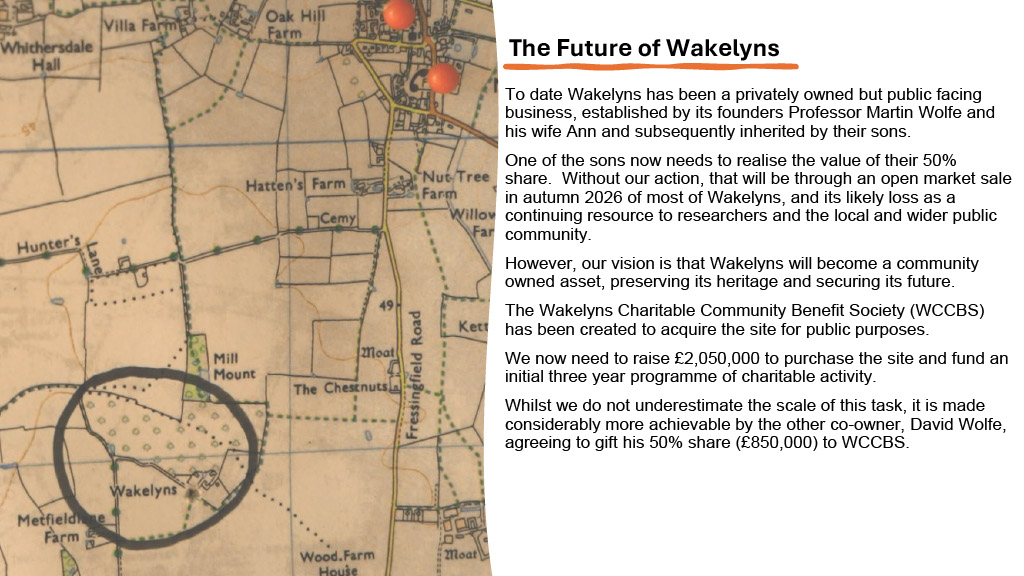
A: Wakelyns has been independently valued £1,700,000. We can secure that whole asset becomes charitably owned by paying half that amount.
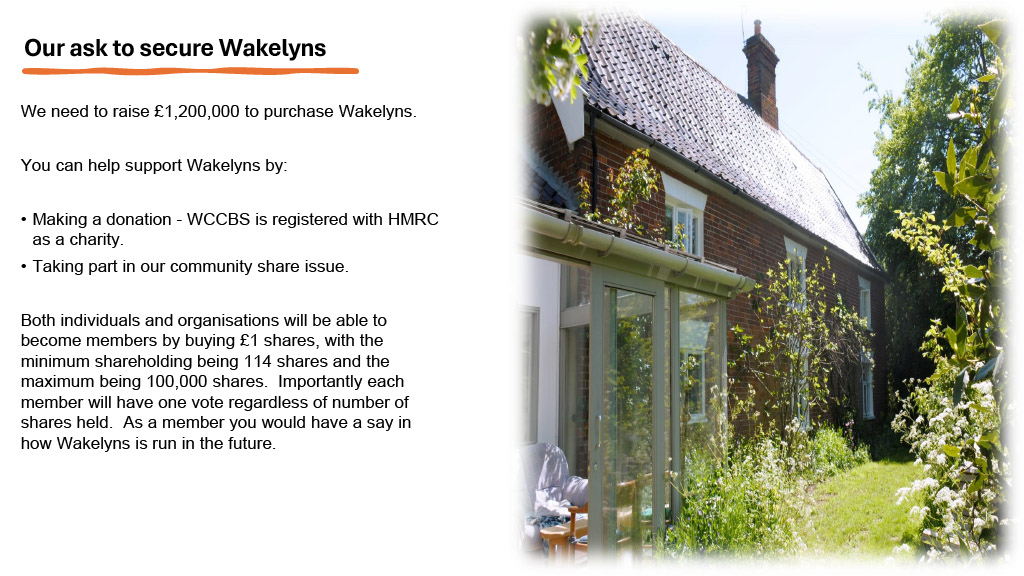
The aim is to raise £1,200,000 of which £850,000 would immediately be used to buy out Toby Wolfe’s share . The remainder will provide the CCBS with funds to upgrade equipment (which is needed to improve the efficiency of some of the farming), employ core staff, and have financial security for its activities going forward. The CCBS will end up owning the entirety of Wakelyns without the need for further expenditure.
A: We have already received donations and pledges of over £100,000. We hope to get more donations including from people becoming Members by buying community shares).
Each WCCBS share costs £1. The minimum shareholding is 114 shares so please subscribe a minimum of £114. You may subscribe for a maximum number of 100,000 shares per person/Member.
Donations alongside a shareholding are particularly helpful to the CCBS because we can claim Gift Aid on donations from UK tax payers.
A person or organisation wishing to provide more than £100,000 could either do that as a simple donation, or could use part of it (up to £100,000) to become a shareholder/member and provide the rest as a separate donation. The donation element in each case will not bring a vote; that comes from being a member.
A: All funds provided at this stage as either membership share purchases or donations will be kept in a dedicated bank account, and we won’t at this stage formally process the membership applications.
If the CCBS does not raise the funds it needs then the funds raised so far would be returned and Wakelyns will be put on the open market. Its future would then be entirely uncertain.
A: Of the various legal structures available, this was by far the most appropriate. It is a well tried and tested model which allows for wide community investment in a way which allows people who have more to invest more, while those with less can still be Members; it offers one member one vote which provides the best democratic governance; it allows for modest interest payments on investments, but avoids the distorting effect of people hoping for significant profit; and it has a strong ‘asset lock’ which will protect the Wakelyns land and buildings for the future.
A: A charitable CBS is a charity (and is more able to, for example, trade, than would be a registered charity). Put another way it is a CBS which operates for charitable purposes (as signed off by HMRC). That legal structure provides greater comfort to investors and donors, allows it to access a wider range of grants, and brings tax benefits when it comes to donations (as the CCBS can claim Gift Aid which makes each donation more valuable to the CCBS).
Profits cannot be distributed to members and must be retained by the Society to further the charitable objects. As a Charitable Community Benefit Society, we have a ‘charitable asset lock’. This is stronger than a statutory asset lock. An asset lock prevents the assets of the organisation from being used for private gain. They can only be used to further the charitable objects of the society. And the Wakelyns site could not be sold and the profit dissipated. The site is secured.
In the event of dissolution after Wakelyns has been acquired, assets must be distributed to another charitable organisation with similar objectives to our own.
A: Community shares are a type of share used by Registered Societies such as a CBS or CCBS. They are non-transferable, withdrawable shares. This means that unlike shares in traditional companies you cannot sell them on to anyone else, but you are entitled to remove your investment subject to the Society Rules.
Community shares have previously been used to finance renewable energy schemes, farms, shops, piers, ferries, pubs, bakeries and more. For more information and case studies around community shares, visit the website of the Community Shares Unit: www.communityshares.org.uk
The Wakelyns CCBS was set up with help from Co-Operatives UK (and its rules are based on their model rules). They have more information about community shares here: https://www.uk.coop/resources/community-shares-handbook-cs
The objects of the Society shall be for the public benefit to:
(a) The promotion of sustainable development through organic agroforestry, agroecological farming and by operating or hosting enterprises on a short ‘food chain’ model to undertake, demonstrate and educate others about sustainable development.
(b) The advancement of environmental protection and improvement through organic agroforestry and agroecological farming to protect and enhance nature and the natural environment and tackle climate change.
(c) The advancement of the arts, culture and science through undertaking and hosting research projects and hosting events relating to healthy food, farming and the environment. (d) The advancement of education through hosting and providing courses, and publishing information relating to farming, the environment and sustainable development.
A: Members vote at AGMs to elect a Board which runs the CCBS. They also vote on any resolutions put to a General Meeting or AGM by the Board or by members.
A: By buying £1 shares, with the minimum shareholding being 114 shares and the maximum being 100,000 shares. Family members can each have shares but each only has one vote. Organisations can be members.
A: You can ask to withdraw your shareholding. It will be for the Board to decide whether/when the CCBS is in a position to buy out the shares of people who want to withdraw. If it decides it can do so, it must do so in the order in which they are requested. It seems unlikely that will be the case in the short term, at least not until the new arrangements are well-settled and secure. Someone who is not being bought out can still withdraw and their shares then become ‘loan stock’ under the CCBS rules.
A: No, the option of having “transferrable shares” introduces lots of regulatory complexity. You would need to withdraw then the next person could invest to the same amount.
A: The CCBS rules allow it to pay up to 3% per year as interest but the aim here is to secure Wakelyns and what happens there, not to provide financial returns for people. It is not a business for financial gain – it is a charity. Any trading surpluses will be reinvested into the Society’s charitable objects for the benefit of both the community and the environment. However, we believe you will receive social and environmental interest in abundance. No-one should invest here relying on an investment return.
A: The Board will be in overall control of the CCBS.
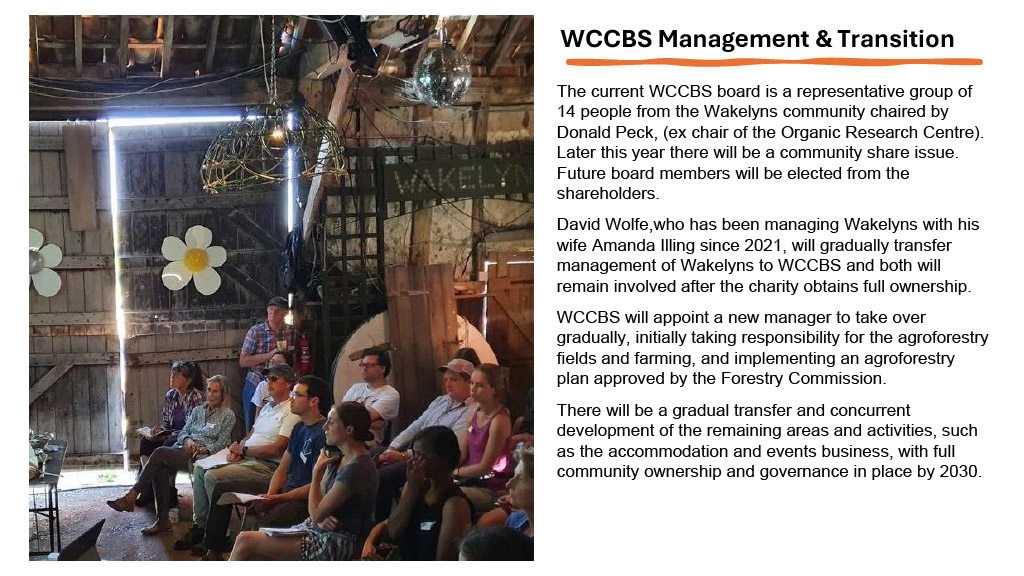
As above, the plan is that the CCBS will initially only take over the running of the organic agroforestry at Wakelyns. It will be up to the Board to decide how it wants to do that: it is likely to try and engage someone to manage that task day-to-day.
In that initial period, David & Amanda will continue the business of running the accommodation and other activities (courses, events, oversight of enterprises, and so on) which are focussed on the area of the site over which they will retain control. The CCBS Founder Members consider that is the best way to ensure the stability and continuity of the range of things which currently happen at Wakelyns. There will need to be agreements in place between David & Amanda on the one hand, and the CCBS Board on the other, about the many things which will operate across Wakelyns as a whole. The plan is that, over time, the CCBS Board will enhance its capacity and be able to take over running the full range of activities, allowing David & Amanda to step back, safe in the knowledge that the overall Wakelyns project is then secured for the future.
A: The current/initial board is Donald Peck (former Chair of the Organic Research Centre), Richard Stein (a retired solicitor), Gavin Sturge (an accountant), and Daniel Hudson (founder and CEO of Proposition Studios, an arts and ecology organisation).
They will oversee the process of fundraising to get us to the point where we can move to acquire Toby Wolfe’s share and the process of phased handover of ownership and control can begin.
At that point, the CCBS will hold an AGM for all the Members at the time. Any of those members will be able to step forward to join the Board (which must comprise at least 3 Board Member and can also include non-executive Directors appointed for their particular skills or expertise).
The Members will vote for the Board who will oversee the following phases of the project. That will be the opportunity to diversify the range of people on the Board including to include people whose interests and expertise span the range of people supporting the Wakelyns project.
A: No, the Board will be elected by the Members and can be removed or overruled by the Members voting.
It will also have to act consistently with the charitable purposes set out in the CCBS founding rules (as to which see further below), and the various constraints which will be written into those rules to protect its current activities and the core essence of what makes it special, but without unduly constraining innovation and its evolution, thus enabling it to remain at the forefront of agroecology (as to which see further below).
As above, the legal ‘asset lock’ means that Wakelyns itself would have to continue to be used for the purposes of the CCBS and could not be sold or used to generate money for any other purpose.
If a Board member is not doing their job properly, the other board members can vote to remove them.
A: David & Amanda want to help secure the future and the transition of ownership and operations to community ownership and management.
They believe that this phased way is a more secure way of doing that – securing stability and continuity through a gradual transfer once the CCBS has the governance and operational capacity to take on what is currently run directly by Amanda and David – than if everything was simply transferred at once.
They intend to remain involved in what happens at Wakelyns, but without owning or being in control; and thus help ensure its resilient future when they are no longer able to assist.
A: We are encouraging folks to provide at least part of any money they offer in the form of a donation because that attracts Gift Aid (which increases the value of the donation to the WCCBS) because the WCCBS is a charity.
If you are happy to proceed that way, then we suggest having a (minimum of) £114 shareholding (and thus being a voting member of the CCBS) and then the rest as a donation (on which the CCBS can then claim Gift Aid).
A: If we don’t achieve the target to progress the Wakelyns purchase, the value of member shares will be returned at that point (having been held in a dedicated bank account to that time).
Beyond that time, the purchase of community shares is at full risk, and investors can lose all or part of their capital invested without recourse to the Financial Ombudsman Service or right to compensation under the Financial Service Compensation Scheme.
On the other hand, if we succeed (and the WCCBS owns Wakelyns with the statutory protection of an asset lock and having secured its full value by only paying half its value) members can still withdraw and ask for the value of their shareholding to be repaid which the Board can decide to do.
Likewise, if the WCCBS does not succeed in raising the necessary funds, then anything received by way of donations at that point would be returned to the donors. However, if we succeed then donations would not then be returnable. But we are encouraging folks to provide at least part of any money they offer in the form of a donation because that attracts Gift Aid (which increases the value of the donation to the WCCBS) because the WCCBS is a charity.
A: Yes, either onto neighbouring land, or onto satellite sites. The current plans entirely allow for that but don’t provide for it to happen yet.
A: Yes, the constraints written into the rules are designed to protect its core essence and provide a steer as to what the Board should do, without preventing innovation and evolution.
The CCBS rules say this:
The Society will:
(a) Acquire, own and manage land, buildings, facilities and equipment including at Wakelyns.
(b) Undertake and/or enable farming and food related activities and trading including through the continued operation of the organic agroforestry system at Wakelyns.
(c) Make available (on terms which may be financial or otherwise) land or buildings, or parts or time shares of those things to people running enterprises whose activities promote the objects of the Wakelyns CCBS.
(d) Host or enable events including educational and recreational events and activities including for the community at large or parts of it which may either be promoting the objects of the Wakelyns CCBS or providing it with income to support its activities.
(e) Provide or enable (on terms which may be financial or otherwise), short or long-term accommodation for persons involved in the activities of the CCBS, enterprises based at Wakelyns, or events taking place at Wakelyns.
(f) Undertake or enable scientific and other research (including natural, social and transdisciplinary science, arts and humanities) that is in line with these objectives and the other provisions of these Rules.
(g) Enter into agreements (on terms which may be financial or otherwise) to facilitate its activities.
(h) To further its charitable purposes, to facilitate and enhance the activities listed above, and to generate surplus funds to support them, the Society will undertake trading involving the provision of courses and events and the selling of Wakelyns’ produce along with food, craft and other items made from that produce and related other items.
The Society is not permitted to engage with:
(a) Activities or products which may materially undermine its organic agroforestry.
(b) Activities or products related to plants or animals that have been genetically modified or gene edited in a way that does not occur naturally or with traditional breeding.
(c) Activities or products related to the production of nuclear power or fossil fuels.
(d) Activities or products related to the manufacture of weapons.
(e) Activities or products related to the killing or harming of animals for sport.
A: We would welcome any help you can give. Please tell your friends! If you are also able to promote through social media or some other form of publication that would be great. Likewise if you are involved in an organisation with a membership list or similar to whom you could pass it all on.
There is text and photos you can use if it is any help here.
Let us know here if you need more information about any of that.
We use Zeffy because, unlike other payment apps, they do not take a cut of your money as a transaction fee (others typically take 1.5-2.0%). What Zeffy does is ask you, the donor, if you want to make a voluntary payment to them too – a bit like a tip. It is entirely up to you whether you do that. It suggests 15% but if you select the “other” option, you can put in zero.
There is also a wrinkle with the emails which Zeffy sends after you make a payment. They describe the payment as an annual recurring payment. Do not worry. That is not the case. Any payment you make is a one-off. If you want later want to give more, then you would need to go via Zeffy again.
A: Anyone, anywhere, can buy shares or donate.
Donations will attract Gift Aid (which helps the CCBS) if you are a UK tax payer, but not otherwise.
Donations can be the sterling equivalent of any currency you choose without restriction.
If you are buying shares we need the application to be in round £’s (not a currency conversion resulting in part of a £) please as £1 is the cost per share and a minimum share membership is £114 (114 shares).
You should be able to do all that through the Zeffy app (as for UK folk). But if you are stuck and for some reason need to do it another way (such as direct to our bank) then please email info@wakelyns.org.uk and we can work out how best to make it happen.
Click on the images below to see great drone footage of Wakelyns and Wakelyns on Countryfile
Click on the images below for a couple of lovely recent films about Wakelyns: Ben from Landing Films and Harry Read from Wakelyns Nature